The rising folk-soul artist’s forthcoming EP Undertow arrives in November via Mandatory Music.
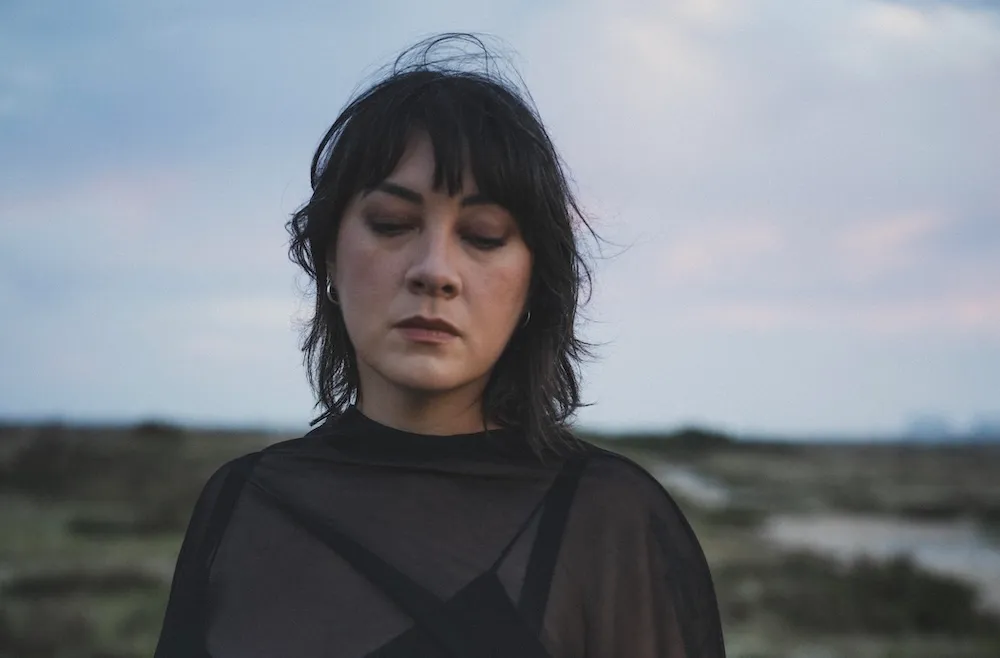
Blending intimate folk songwriting with soulful vocals and lush, evocative arrangements, rising singer-songwriter Ruby Alexander creates music that feels both deeply personal and transportive. Raised between Greek and Chinese cultural influences in Australia and now splitting her creative life between Australia and New York, Alexander draws from a diverse array of experiences, using music to explore the spaces between identity, memory, dreams, and the natural world.
Her forthcoming EP Undertow promises to expand on those themes, moving between sparse, introspective moments and warm, collaborative arrangements that reflect the emotional push and pull of her songwriting. In the conversation below, Alexander discusses how her multicultural upbringing has shaped her artistic perspective, the ocean’s recurring presence in her work, her visually driven creative process, and her desire to make music that encourages listeners to disconnect from the outside world and reconnect with themselves.
As someone who grew up between different cultural backgrounds and is now making music both in Australia and the US, do you feel that those different places and experiences have shaped the way you understand yourself as an artist?
Definitely. I think they’ve shaped me in ways that I haven’t yet realized, and probably with hindsight, it’ll all come together. But up until now, I write from a place that is pretty uprooted. When I listen to my music, I can’t quite place it, as in, it doesn’t necessarily feel American or Australian. I come from a Greek and Chinese upbringing too, and feel lucky to be drawing from such a diverse pool in so many ways, but I think that it has culminated in rootlessness. I enjoy this because I think I can place my music in a realm that is separate from my own day-to-day life. And it’s a bit of escapism.
In terms of musical influences, I grew up listening to a lot of American music. That’s actually what drew me to like New York in the first place.
It feels like there’s definitely a natural flow to my writing process, but I have to access a part of myself to get it. The way that I understand it is that for some people, like my partner, they can sit down and write a song almost immediately. For him, it just flows out and he can accept whatever comes. But for me, I sit down and it’s not on the surface. I have to get to a place of openness in myself before it can come. Usually the first few lines, the melody and the lyrics come together. From there I chip away. Sometimes it’s a few hours or I have to set it down and come back over a couple of days, not usually longer than about three days. It really feels like something frustrating but equally rewarding. I want my music to be a place to rest, as in, you can kind of step outside yourself and your worries and just be present someplace else.
“Undertow” is the second single from your upcoming EP, which comes out in November. What does the record reveal about you or your songwriting that you feel the first two singles only begin to introduce?
I chose the first two singles because they’re quite different, sonically. They are the two extremes of arrangement and emotion. One of them feels like it’s giving more: external and outwards. The other feels more interior. So I think that the rest of the EP fills in the space between those extremes. It charts the different levels from the interior to the exterior. From loneliness, in the form of a sparse arrangement, to a community, a communal experience of musicians playing together. The whole EP was recorded with all the musicians playing at once in the room, where we’d get a full take, and then I would overdub vocals. There was a very collaborative aspect to it.
The EP crosses between the dream world. It feels very subterranean to me, and foggy, like places with no kind of resolution and more of a mercurial, dark, dream world. That then meets a sun-drenched, warm, tangible space with some placeholders and markers of a physical world. In my lyrics, I draw from nature quite a lot. I think that probably comes from my Australian upbringing. From dreams to reality, and from the inner to the outer, I think that’s what Undertow covers.
As a painter myself, I can relate to musicians because it’s like we’re tapping into the same sort of emotions, just doing it in the complete opposite way. Like we’re both putting out these emotions and then we still have to afterwards translate it into words. I think even with songwriting, like even though there’s lyrics, it’s poetic. The audio version of a painting.
I’m jealous of visual artists.
I’m jealous of musicians!
We need to join forces. I feel my songs first come to me visually, it’s like that kind of emotional world you sit in, and then I have to find a way to put it into words. I don’t have the visual means or capabilities of painting, otherwise I probably would have loved to try it.
Your music draws heavily on emotional atmosphere and storytelling. Are there particular memories, places, or images that tend to find their way into your songwriting?
I think the ocean does a lot, just because I grew up right by it. Even when I’m not near it, I think about it a lot: in the ways that it can be so ruthless but also comforting. Then there are places I think I could go, like imaginary places that blend physical environments. I register images first as sensory details and feelings. One of them is being on the edge of something very expansive, but not reaching it. It could be a metaphor for an ‘almost fulfillment’ and ‘almost knowing’, but simply not being able to reach it. So that kind of comes up in different ways, whether that’s like being on the edge of the sea or being on the outskirts of the city, or the corridor between shadow and a light room, something lit up. So I think I’m drawn to the edges of things that move. Apart from that, I think I just find natural scenes easier to write about.
When someone sees you perform live at one of your shows, what do you want them to walk away feeling?
I want them to walk away knowing that they were there, as in, they were somewhere, that they did something, and were present. The reason I love live music or going to a gallery, being in a physical space of interacting with artists’ work is that it’s a very valuable real life experience. I’m craving that right now. On a day to day level, a lot of us sometimes just get to the end of the day, living through a screen. So I think I just want someone to walk out of that way of being and feel reconnected in a space: being with other people, listening… a space of recognition. On another level, I just want them to feel. I know I don’t really make joyful music right now. It’s not quite music you can dance to, but I think it’s music you can feel a sense of curiosity in. So it’ll be nice if someone leaves feeling that they’re curious about something. Whether it’s just questioning themselves again, or something that can get them a little bit closer to themselves.
I found it to be just very rhythmic. Almost like there’s, like, an emotional sort of echoing. Your voice is very soulful, there’s so much emotion behind your performance.
I think that that’s what I enjoy most about playing live: the emotion. When I perform, I want people to feel seen in an emotional way. Sometimes it feels so vulnerable that at the end of a set, I am exhausted, in the best way. I hope that I can reach people.